
Where Every Era Left a Mark

From court and gaol to riverside inn, still rooted in Northumberland craft.

Prefer the short version? Jump to the timeline

Chronicle

The Anchor stands on ground long tied to local justice and hospitality. Records point to an inn here in 1422, when the site also served as a court and gaol. A century later, a letter from the Earl of Northumberland to Cardinal Wolsey in 1528 mentions the execution of Jamys Noble.

Through the early modern period the premises formed part of the leet and court baron of the Barony of Langley. After the 1715 Jacobite rising, Radcliffe lands were confiscated and administered via Greenwich Hospital.

By the mid-eighteenth century the house had taken the name “The Anchor,” a nod to that Admiralty link. Reports speak of a courthouse on the south bank with a commodious inn raised by the commissioners. What was known as the Admiral’s House, now incorporated within the hotel, accommodated their receivers on business.

In the coaching era the Anchor grew busy thanks to its midway position between Newcastle and Carlisle. In 1812 it became the original meeting place of the Haydon Hunt, often cited as the oldest hunt in Northumberland.

Today

Still an inn and café by the River Tyne, with simple rooms and breakfast, a lively bar, and a quiet garden welcoming walkers, cyclists and families.
TIMELINE

Swipe to explore

  1. 1422

    Court & Gaol

    Earliest reference to an inn here, alongside a courthouse and gaol.

  2. 1528

    Wolsey Letter

    Earl of Northumberland writes to Cardinal Wolsey; Jamys Noble is mentioned.

  3. 1715

    Admiralty Estate

    After the rising, Radcliffe lands are managed via Greenwich Hospital.

  4. c.1750s

    “The Anchor”

    Name in use; courthouse and commodious inn on the south bank.

  5. 1812

    Haydon Hunt

    Original meet for what’s often cited as Northumberland’s oldest hunt.

  6. 1900s

    Riverside Tavern

    Local ales and salmon suppers become house staples.

  7. Today

    Inn & Café

    Rooms with breakfast, a lively bar, and a quiet garden café.

  8. 2025

    Heritage Plaque

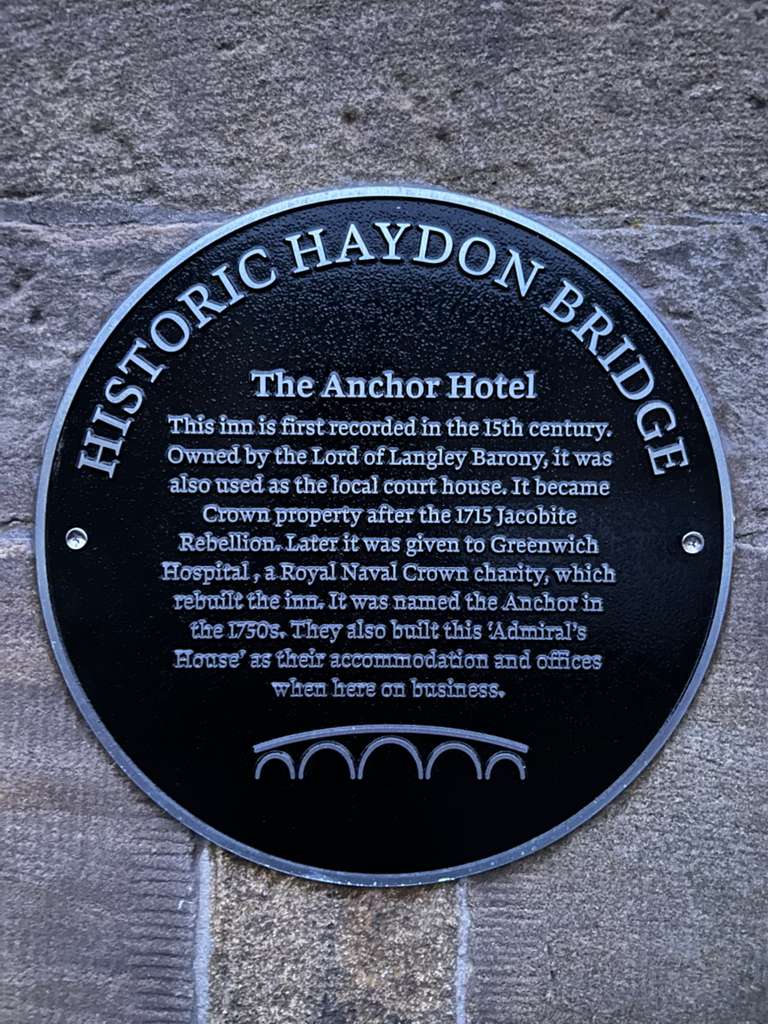
    Marks six centuries of life on the South Tyne: courthouse roots, Crown history, and the riverside inn that endured.

Heritage plaque at The Anchor Hotel

2025 Heritage Plaque

Recognising the Anchor's six-century role in Haydon Bridge, from courthouse and Crown history to riverside inn.

Read the inscription

"This inn is first-recorded in the 15th century. Owned by the Lord of Langley Barony, it was also used as the local court house. It became Crown property after the 1715 Jacobite Rebellion. Later it was given to Greenwich Hospital, a Royal Naval Crown charity which rebuilt the inn. It was named the Anchor in the 1750s. They also built this 'Admiral's House' as their accommodation and offices when here on business."

Heritage Plaque

Heritage plaque at The Anchor Hotel
Tap image to zoom

Visit the Anchor today

Six centuries on, The Anchor still welcomes travellers, walkers and families beside the River Tyne. Simple rooms with breakfast, honest Northumbrian plates, and a lively bar make it a proper base for exploring Hadrian's Wall Country.

Sources & Acknowledgements

  • Parish records and Barony of Langley court references (1422 onwards).
  • Letter from the Earl of Northumberland to Cardinal Wolsey (1528).
  • Greenwich Hospital estate papers (post-1715 administration).
  • Local histories of Haydon Bridge and the Haydon Hunt.
  • With thanks to the Haydon Bridge Local History Society.